Preface
The ever-changing landscape of education has transformed the role of teachers from mere transmitters of knowledge to facilitators of meaningful and active learning. As classrooms become increasingly diverse and learner-centered approaches gain greater emphasis, pre-service teachers are expected to develop the knowledge, skills, and flexibility needed to meet the demands of contemporary education. Among these approaches, constructivism has emerged as a significant educational philosophy that encourages students to actively construct knowledge through collaboration, inquiry, and authentic learning experiences.
This monograph presents a study that examines the teaching practices of pre-service English teachers within the current educational context. It explores the extent to which constructivist principles are reflected in their instructional practices, the challenges they encounter in implementing learner-centered teaching, and the strategies they employ to address these challenges. By understanding their experiences, this work aims to contribute to the ongoing discussion on improving teacher preparation and enhancing classroom instruction.
Drawing upon qualitative data gathered through semi-structured interviews with ten pre-service English teachers from the Ilocos Sur Polytechnic State College (ISPSC) community, this study provides valuable insights into the realities of teaching during the practicum experience. The findings reveal that while pre-service teachers integrate various instructional approaches—including structured lessons, differentiated instruction, game-based learning, collaborative activities, and the activation of prior knowledge—the consistent implementation of constructivist teaching is often influenced by classroom management demands, curriculum requirements, limited instructional resources, and the diverse learning needs of students.
Recognizing these realities, this monograph proposes a constructivist-based intervention material designed to support pre-service English teachers in planning and delivering more learner-centered, engaging, and flexible instruction. It is hoped that this resource will serve not only as a practical guide for future educators but also as a reference for teacher educators, cooperating teachers, curriculum developers, and educational researchers who are committed to strengthening teacher preparation programs.
To access the complete research volume, please use the digital reader or download links below.

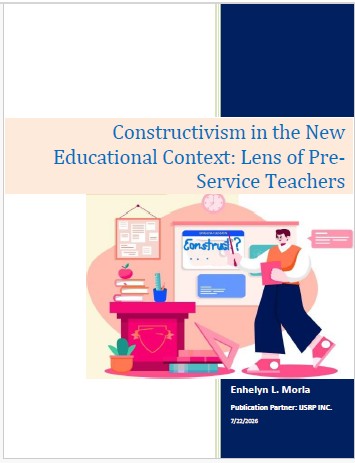
 Title: Constructivism in the New Educational Context: Lens of Pre-Service Teachers
 [ONLINE READER]
 [DOWNLOAD FULL PDF]