Abstract & Preface
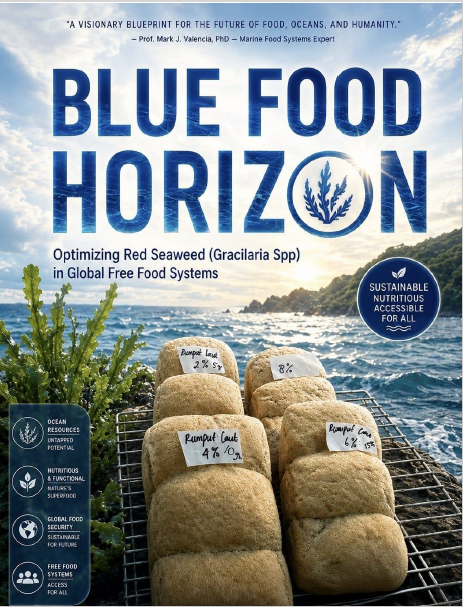
The rapid changes in global food systems highlight the urgent need for sustainable, nutrient-rich, and climate-resilient options. Agriculture has historically focused on land resources, but this approach faces constraints from land degradation, freshwater shortages, and rising greenhouse gases. The concepts of "Blue Food" and the "Blue Economy" emphasize marine ecosystems' importance for future food security, economic stability, and growth. This monograph, "Blue Food Horizons: Optimizing Red Seaweeds (Gracilaria spp.) in Global Free Food Systems," explores the shift to blue food sources, linking local innovation with global sustainability by analyzing how aquatic biomass can address land-based diet gaps, especially reducing reliance on imported wheat and tackling nutritional deficiencies of gluten-free starches.
This study combines two local ingredients: Modified Cassava Flour (Mocaf), a fermented land-grown flour supporting food sovereignty but lacking protein and fiber, and Red Seaweed (Gracilaria spp.), a marine resource rich in amino acids, minerals, and natural thickeners. The research builds on our peer-reviewed article: Yusuf, M., Odongo, S. A., Hersoelistyorini, W., & Suyanto, A. (2025). 'Sustainable Blue Food Innovation: Optimization of Gluten-Free Bakery Products Enriched with Red Seaweed (Gracilaria Spp)'. Asian Food Science Journal, 24(12), 129-139.
This monograph builds on primary study data, detailing the collection and stabilization of raw Gracilaria spp. biomass from Demak, Central Java. It discusses its use in Mocaf-based baking matrices at substitution levels (0% to 8%) and the physicochemical and sensory tests conducted. The work expands on the Composite Performance Index (CPI) from the original publication, showing that optimal formulations balance nutritional content with sensory appeal, not just maximize nutrition. The study explains why the 4% substitution (Treatment P2) serves as a "functional ceiling,' achieving 21.58% crude fiber five times higher than typical gluten-free standards while maintaining desirable viscoelastic, moisture, and organoleptic qualities.
We hope this monograph serves as a detailed scientific guide for food scientists, culinary developers, policymakers, and advocates of the blue bioeconomy. By converting underused coastal resources into nutritious, autonomous food solutions, we can set a realistic and sustainable course for the future of blue foods.
To access the complete research volume, please use the digital reader or download links below.

 Title: Blue Food Horizons: Optimizing Red Seaweeds (Gracilaria spp) in Global Free Food Systems
 [ONLINE READER]
 [DOWNLOAD FULL PDF]